Imaging setup
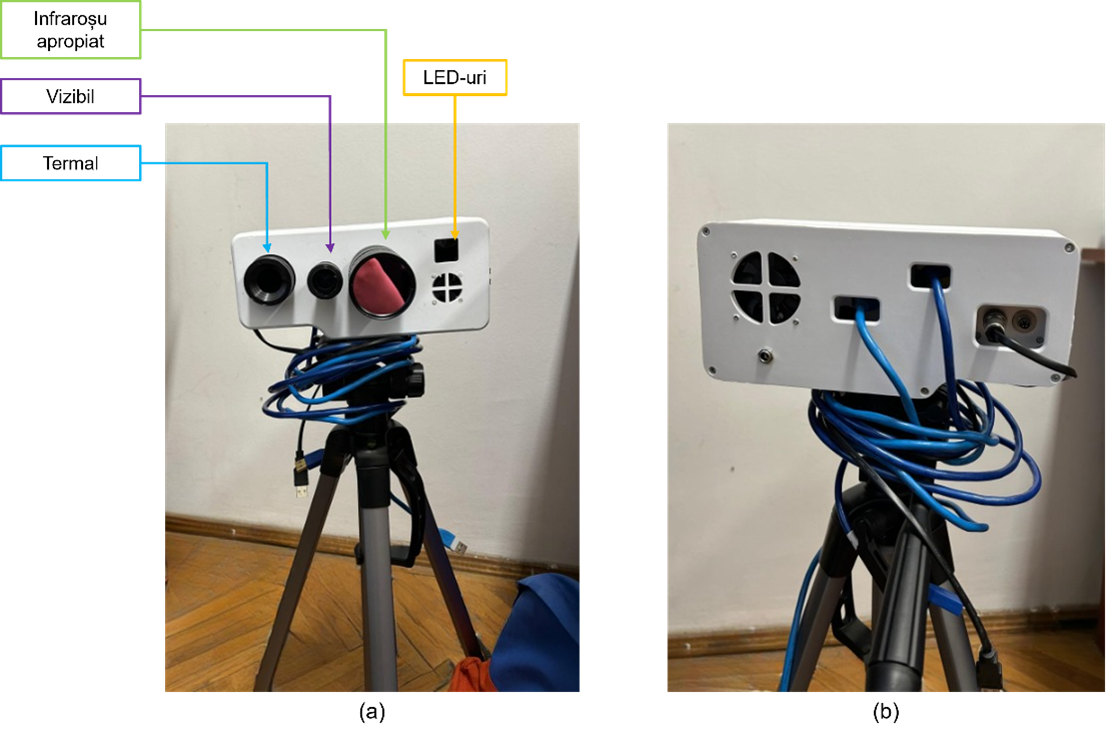
The MelanoDet infrastructure is built around a compact, clinic-ready imaging rig that integrates three synchronized cameras: a visible (VIS) camera for high-resolution colour imaging, a near-infrared (NIR) camera for subsurface structures, and a long-wave infrared (thermal, TH) module for temperature mapping. The cameras share a common field of view of about 25 × 25 mm at a fixed working distance of ~250 mm, ensuring that the same skin region and a small fiducial marker are captured simultaneously in all modalities.
Clinical infrastructure
Imaging sessions are conducted in a quiet, temperature-controlled clinic room, with stable ambient conditions (≈22–24 °C) and carefully managed lighting. The workflow is tightly integrated with dermatology practice: patients are recruited during routine consultations, lesions are selected and mapped by the dermatologist using standard dermoscopy systems, and the MelanoDet acquisition is performed immediately afterwards. Standard handheld and digital dermoscopic images are stored alongside VIS/NIR/TH data, enabling multimodal comparison and longitudinal follow-up.
Data and software infrastructure
The project uses a lightweight, file-centric database stored on local HDD, structured into separate areas for raw, processed and derived data:
- raw/ for original VIS, NIR, static TH frames, dynamic thermal sequences, and optional clinical documents;
- processed/ for registered triplets and lesion-centered crops;
- annotations/ for lesion-level labels, image-level ROIs, and (when available) pixel-level masks.
A stable naming convention links all modalities and sessions using anonymized patient ID, date, lesion index, and modality code, making it straightforward to join images with metadata and annotations. Automated Python tools handle image validation, metric computation and PASS/FAIL decisions before data are promoted into the central research archive.
Governance, ethics and risk management
The data infrastructure is designed “privacy-first”: personal identifiers are stripped before ingestion, datasets are indexed only by coded IDs, and any linkage to hospital records is stored separately under restricted access. Role-based access control, audit logging and encryption are used to enforce GDPR compliance and to protect sensitive mappings.
Together, this infrastructure provides a robust foundation for collecting, curating and analyzing multimodal skin-lesion data, and for gradually transitioning MelanoDet from lab validation to real-world clinical pilots.